
Drone Heat Sink Design: Thermal Management for ESCs, VTX, and AI Processors
Drone heat sink design manages component temperature within a strict weight budget by matching the heat sink's manufacturing method and alloy to each heat source. Die-cast aluminum integrates cooling fins directly into structural housings for ESCs and edge AI processors, while extruded aluminum delivers higher base conductivity for linear-fin cooling of high-power electronics. Standard die-cast alloys such as ADC12 and A360 provide a thermal conductivity of roughly 96–115 W/m·K with full three-dimensional geometric freedom, whereas extruded 6063 reaches about 200 W/m·K but is limited to constant cross-section profiles. (For cast designs requiring ~150 W/m·K, gravity-cast A356-T6 or specialized high-thermal-conductivity die-cast alloys are utilized).
Three variables drive drone heat sink selection: the heat load and junction-temperature limit of each component, the airflow regime (natural convection versus propeller-driven forced convection), and the weight penalty the airframe can absorb. This guide establishes the thermal, material, and manufacturing criteria for designing heat sinks for UAV ESCs, high-power video transmitters, AI companion computers, and motors, written for drone thermal and hardware engineers.
Why Thermal Management Determines Drone Reliability and Flight Time
Thermal management governs drone reliability because semiconductor components lose performance and lifespan as junction temperature rises, with most ESCs and flight-controller MCUs rated for continuous operation only up to 85–125°C. Each 10°C above rated temperature roughly halves the service life of power electronics, so inadequate heat dissipation causes mid-flight throttling, ESC shutdown, or premature failure. Cast aluminum dominates UAV heat sink production because it combines usable thermal conductivity with the geometric freedom to integrate fins into a structural housing, removing the separate heat-sink mass that a weight-constrained airframe cannot afford. Higher fin density and larger base area improve heat transfer but add weight and can block airflow, so drone heat sinks must be sized against the convection actually available in flight. Thermal performance is quantified as thermal resistance in °C/W, the temperature rise per watt dissipated, which sets the allowable heat load for a given temperature limit.
Heat Sources in a Drone and Their Cooling Requirements
Electronic speed controllers (ESCs): Dissipate the most concentrated heat under high current; require low-thermal-resistance mounting, often directly integrated into a die-cast housing.
Edge AI Companion Computers & VTX: While standard flight controller MCUs are low-power, onboard AI processors (e.g., NVIDIA Jetson) and high-power digital video transmitters generate intense, continuous heat. They are highly sensitive to thermal throttling and require dense-fin or skived heat sinks, often positioned in forced airflow.
BLDC motors: Generate heat at the stator. Cooling relies heavily on forced convection (propwash) from the rotating blades. While most modern drones use carbon fiber arms that act as thermal insulators, heavy-duty industrial drones may utilize aluminum arms where die-cast motor mounts can act as a supplementary conductive heat path.
Die-Cast Aluminum Heat Sinks for Drones
Die-cast aluminum is the method specified when the heat sink must integrate with a structural housing or carry complex three-dimensional fin geometry. Standard alloys such as ADC12 and A360 provide thermal conductivity of about 96–115 W/m·K and excellent castability, letting fins, mounting bosses, and enclosure walls form in a single net-shape cycle that eliminates separate heat-sink mass and assembly joints. High-pressure die casting (HPDC) can reproduce pin-fin arrays and non-linear fin patterns matched to propeller-driven airflow. Although entrapped-gas porosity can slightly reduce as-cast thermal conductivity, controlled casting pressure and gating mitigate this. Die-cast heat sinks perfectly suit ESC housings, camera enclosures, AI processor shells, and any UAV component where thermal and structural functions must combine.
Extruded and Skived Heat Sinks for Drones
Extruded aluminum is the method specified when maximum base conductivity and low tooling cost outweigh geometric flexibility. Extrusion alloy 6063 reaches about 200 W/m·K—higher than any common die-casting alloy, because its dense, pore-free structure conducts heat more efficiently—but its fins must run in a single constant direction along the profile. Skived heat sinks, cut from a solid aluminum or copper block, achieve very high fin density from one material with no joint resistance, and copper skiving reaches roughly 400 W/m·K for concentrated high-power loads at a significant weight penalty. Extruded and skived heat sinks suit planar electronics and processors where fins can easily align with forced airflow.
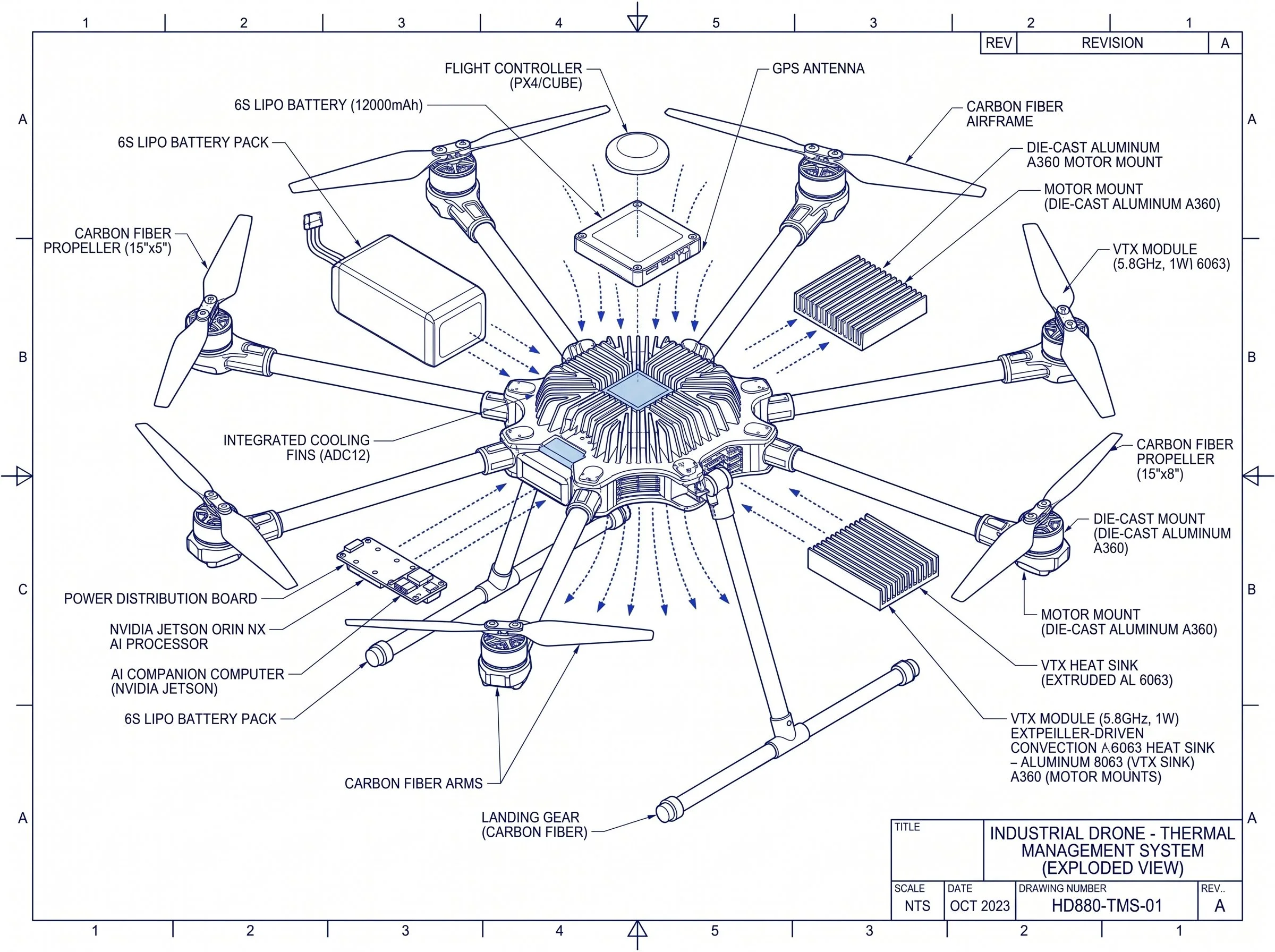
Conceptual blueprint illustration showing heat sink placement and cooling components for industrial UAV.
Die Casting vs. Extrusion vs. Skiving vs. Forging
| Method | Typical alloy / conductivity | Fin geometry & housing integration | Tooling & volume fit |
|---|---|---|---|
| Die casting | ADC12 / A360, ~96–115 W/m·K | 3D pin-fin or non-linear fins; integrates directly with housing | High tooling; >~5,000/yr (with 3D integration) |
| Extrusion | 6063, ~200 W/m·K | Linear constant-section fins; no integration | Low tooling; any volume |
| Skiving | Al or Cu, base conductivity (Cu ~400 W/m·K) | High-density parallel fins; no integration | Low–medium tooling |
| Forging | Dense aluminum, high | Moderate 3D; limited integration | High tooling; high volume |
Engineers selecting a heat sink method for a specific UAV component are invited to submit thermal targets and geometry for a no-commitment manufacturability review covering fin geometry, base thickness, and die-cast alloy selection.
Design Parameters for Drone Heat Sinks
Thermal resistance target: Size the base and fin area to hold the junction temperature below the rated limit at worst-case ambient and power.
Base thickness and spreading: Provide enough base to spread heat from a small die footprint before it reaches the fins.
Forced convection from propellers: Position heat sinks in propwash, which raises dissipation several times over still-air natural convection. Use pin fins for multidirectional propwash, and straight fins where flow direction is fixed.
Weight and integration: Integrate the heat sink into the housing to avoid the mass and joint resistance of a bolted-on part.
Common Engineering Questions
1.Which aluminum alloy is best for a die-cast drone heat sink?
A360 is generally the best die-casting alloy for drone heat sinks because it offers thermal conductivity near 150 W/m·K—higher than ADC12's roughly 96 W/m·K—while retaining good castability for thin fins. Where cost and high-volume castability dominate, ADC12 remains the standard choice, accepting lower conductivity for easier filling of complex geometry.
2.How does forced convection from propellers change drone heat sink design?
Propeller-driven forced convection raises a heat sink's dissipation capacity several times over still-air natural convection, so heat sinks positioned in propwash can use denser, shorter fins than a passively cooled design. Fin orientation should follow the dominant airflow vector, and pin-fin arrays practical only with die casting, performing best under the turbulent, multidirectional flow beneath rotors.
3.When is a die-cast heat sink more cost-effective than extrusion?
A die-cast heat sink becomes more cost-effective than extrusion above roughly 5,000 units per year, where high tooling cost amortizes across short casting cycles and integrating the heat sink with the housing removes secondary machining and assembly. Below that volume, extruded 6063 at about USD 2–5 per unit is the lower-cost option for simple linear-fin designs.
From Thermal Design to Production: Teamsworld's Heat Sink Methodology
Teamsworld manufactures die-cast aluminum heat sinks as a core product line, producing both the tooling and the finished thermal components for lighting, ICT, and UAV programs. The DFM review evaluates fin thickness, draft angle, base spreading, and alloy selection, typically ADC12 or A360, before any steel is cut, and mold flow simulation predicts fill, porosity, and the localized conductivity loss porosity causes, so thermal performance is validated against junction-temperature targets prior to tool commitment. Because Teamsworld integrates high-pressure die casting with CNC finishing of mating and mounting surfaces, a drone heat sink and its structural housing can be produced as one qualified part, typically reducing tooling iterations to dimensional sign-off from three to four cycles to one to two.
Interested in starting your drone heat sink manufacturing journey?
Teamsworld's engineering team provides a no-commitment DFM assessment for your drone heat sink, covering fin geometry, base thickness, draft angles, gate strategy, and ADC12-versus-A360 alloy selection matched to your heat load and airflow conditions. Submit your component thermal targets and geometry to receive a manufacturability review before tooling is committed.