
ADC12 vs. AZ91D for Drone Structural Hubs: Magnesium or Aluminum for Maximum Flight Time?
For drone structural hubs, chassis enclosures, and component housings, AZ91D magnesium and ADC12 aluminum are two premier die-casting alloys. The choice hinges on trading maximum weight reduction against thermal performance, EMI shielding, and cost: AZ91D is roughly 33% less dense than ADC12 and delivers higher strength-to-weight with superior vibration damping, while ADC12 provides higher thermal conductivity, lower raw material cost, and excellent fluidity for complex geometry.
AZ91D has a density of 1.81 g/cm³, about 230 MPa ultimate tensile strength, 160 MPa yield strength, 3% elongation, and thermal conductivity near 72 W/m·K. ADC12 has a density of 2.68 g/cm³, 180–230 MPa tensile strength, 120–150 MPa yield strength, and higher thermal conductivity of about 96 W/m·K.
Three variables drive the AZ91D-versus-ADC12 decision for UAV structural components: the flight-time or payload gain available from lower structural mass, the thermal load dissipated from adjacent motors and electronics, and target production volume. This guide establishes the metallurgical, thermal, and manufacturing criteria for selecting between magnesium and aluminum die-cast drone components, written for UAV hardware engineers and procurement decision-makers.
Why Structural Component Alloy Selection Determines Drone Endurance
Drone endurance is bounded by the airframe's total mass fraction, where every gram of structure removed converts directly into additional battery capacity, payload, or flight time. While carbon fiber composites (CFRP) dominate linear motor arms and tubes, die casting dominates complex 3D central hubs, motor mounts, gimbal housings, and electronics enclosures. High-pressure die casting forms thin-wall structural shells with integrated mounting bosses, wire conduits, and cooling fins in a single net-shape cycle, eliminating separate fasteners and assembly mass.
The engineering trade-off is that magnesium and aluminum optimize different objectives: AZ91D optimizes minimum mass, electromagnetic interference (EMI) shielding, and vibration damping, while ADC12 optimizes thermal dissipation, structural fluidity, and unit cost. Specifying the wrong alloy sacrifices either endurance, signal integrity, or thermal margin. Both are custom die casting alloys defined by standards such as ASTM B94 and the Aluminum Association designations, which fix the composition limits referenced below.
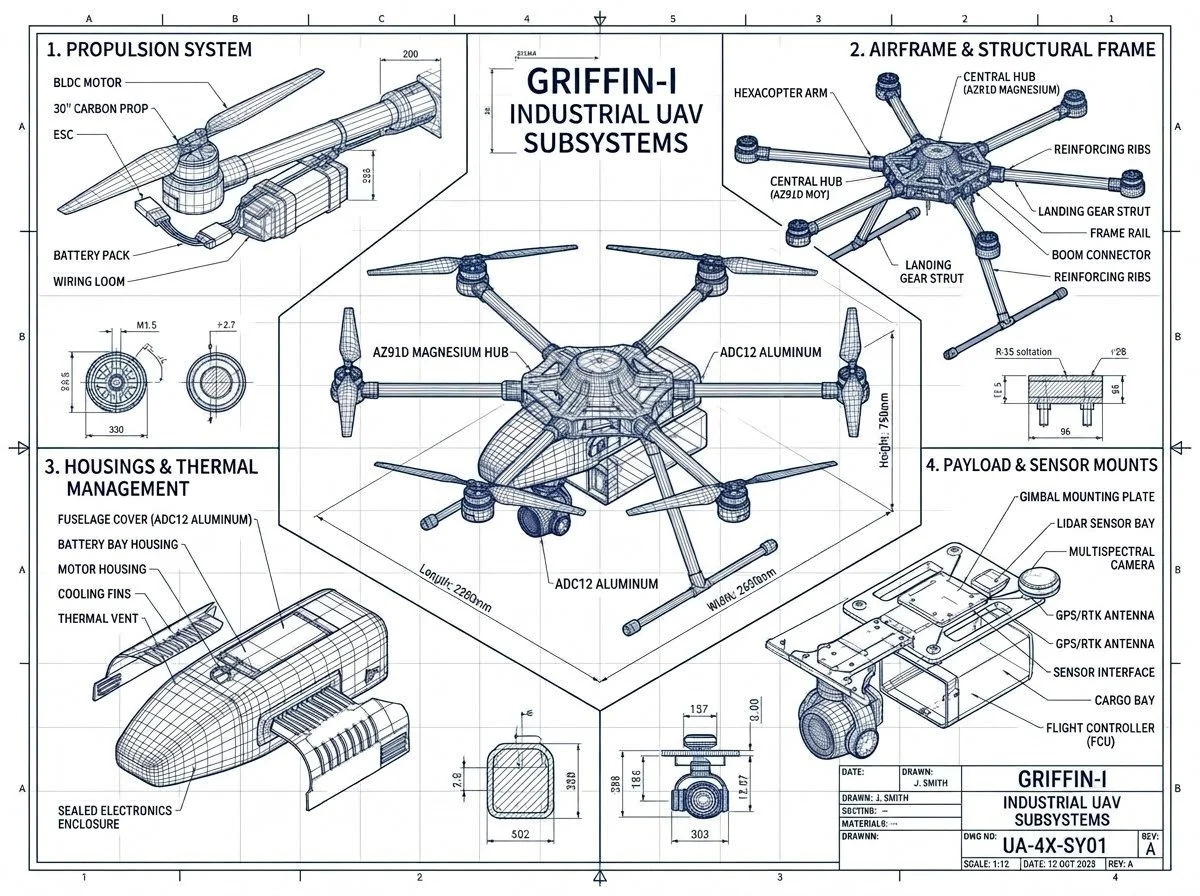
Conceptual wireframe schematic illustrating industrial hexacopter drone subsystems, thermal management housings, and component layouts.
AZ91D Magnesium: Properties and UAV Component Applications
AZ91D is the alloy specified when minimizing metallic structural mass is the dominant design driver. At a density of 1.81 g/cm³, roughly 33% lighter than aluminum, it delivers high specific strength, making it ideal for central structural hubs and payload mounts.
Beyond weight reduction, AZ91D provides two critical engineering advantages:
Vibration Damping: Exceptional damping capacity absorbs high-frequency motor vibrations, protecting sensitive flight controller IMUs and stabilizing camera payloads.
EMI Shielding: Inherent electromagnetic shielding blocks interference between high-power video transmitters and onboard GPS/receiver modules.
High-purity AZ91D resists atmospheric corrosion better than primary magnesium, but outdoor UAV applications still require protective surface treatments (such as micro-arc oxidation or e-coating) to prevent galvanic corrosion at fastener interfaces. Its thermal conductivity of ~72 W/m·K makes it best suited for structural load-bearing frames and enclosures rather than high-power thermal sinks.
ADC12 Aluminum: Properties and UAV Component Applications
ADC12 is the alloy specified when thermal management, structural fluidity, and unit cost outweigh absolute weight reduction. Its 9.6–12% silicon content gives exceptional fluidity, allowing high-pressure die casting to fill ultra-thin, complex sections repeatably. Its thermal conductivity of ~96 W/m·K allows structural enclosures to double as passive heat spreaders for ESCs, VTX modules, and processors.
With a density of 2.68 g/cm³ and tensile strength of 180–230 MPa, ADC12 is heavier than AZ91D but significantly lower in raw material cost. However, because ADC12 contains 1.5–3.5% copper (Cu), outdoor UAV components require a surface treatment (such as anodizing, chromate conversion, or powder coating) to prevent pitting and micro-galvanic corrosion in humid or coastal environments.
ADC12 vs. AZ91D Comparison
| Property | AZ91D (Magnesium) | ADC12 (Aluminum) |
|---|---|---|
| Density | 1.81 g/cm³ | 2.68 g/cm³ |
| Ultimate Tensile Strength | ~230 MPa | 180–230 MPa |
| Yield Strength | ~160 MPa | 120–150 MPa |
| Elongation | ~3% | 1–3% |
| Specific Strength (UTS/Density) | ~127 kN·m/kg | ~80–86 kN·m/kg |
| Thermal Conductivity | ~72 W/m·K | ~96 W/m·K |
| Vibration Damping | Superior | Moderate |
| EMI Shielding | Excellent | Good |
| Outdoor Corrosion Requirement | Requires MAO / E-coating | Requires Anodizing / Powder Coating (due to Cu content) |
| Relative Material Cost | Higher | Lower |
Engineers weighing mass against thermal margin for a specific UAV platform are invited to submit airframe geometry for a no-commitment manufacturability review covering wall thickness, draft angle, and AZ91D-versus-ADC12 selection.
Matching Alloy to Drone Type and Component
Gimbal Mounts & Camera Brackets: AZ91D, leveraging superior vibration damping to stabilize imaging payloads.
Central structural hubs & Electronics chassis: AZ91D, where mass reduction extends flight time and integrated EMI shielding protects avionics.
Integrated ESC/Motor thermal enclosures: ADC12, where higher thermal conductivity dissipates power electronics heat.
High-volume, cost-sensitive platforms: ADC12, for lower raw material cost and high-fluidity thin-wall casting.
Common Engineering Questions
1.Does AZ91D magnesium require corrosion protection for outdoor drones?
High-purity AZ91D resists corrosion well because iron, nickel, and copper are held to low limits, but outdoor UAVs still require a conversion coating or paint on exposed surfaces to prevent galvanic attack at fastener and dissimilar-metal interfaces. Coated AZ91D airframes routinely achieve multi-year field service in humid and coastal conditions.
2.How much flight time does switching from ADC12 to AZ91D add?
Switching an airframe from ADC12 to AZ91D reduces structural mass by roughly 33% for the same geometry, and because the airframe is typically 15–25% of a drone's total weight, the change usually yields a 5–8% reduction in all-up mass, translating into a comparable single-digit percentage gain in flight time or added payload.
3.Which alloy better dissipates heat from drone motors and electronics?
ADC12 dissipates heat better than AZ91D, with a thermal conductivity of about 96 W/m·K versus 72 W/m·K for magnesium, a roughly 33% advantage that lets aluminum airframes act as passive heat sinks for motor mounts and electronics bays. Designs with high continuous power draw favor ADC12 or a hybrid structure using aluminum in the thermal zones.
From Design to Production: Teamsworld's DFM and Mold Flow Methodology
Teamsworld manufactures both the tooling and the cast airframes for UAV programs, operating hot-chamber magnesium die casting and cold-chamber aluminum die casting under one roof, so a design can be quoted in either AZ91D or ADC12 without changing suppliers. The DFM review evaluates wall thickness, draft angles, gate strategy, and alloy selection before any steel is cut, and mold flow simulation predicts fill behavior, porosity, and shrinkage for each candidate alloy against thin-wall and weight targets. With CNC finishing and continuity from prototype tooling through qualified production, Teamsworld typically reduces tooling iterations to dimensional sign-off from three to four cycles to one to two.
Interested in starting your drone component manufacturing journey?
Teamsworld's engineering team provides a no-commitment DFM assessment for your drone structural components, covering wall thickness, draft angles, gate strategy, and magnesium-versus-aluminum alloy selection matched to your endurance, thermal, and volume targets. Submit your component geometry and target quantities to receive a manufacturability review before tooling is committed.