
Aluminum Die Cast Engine Cylinders for UAV Powertrain Reliability
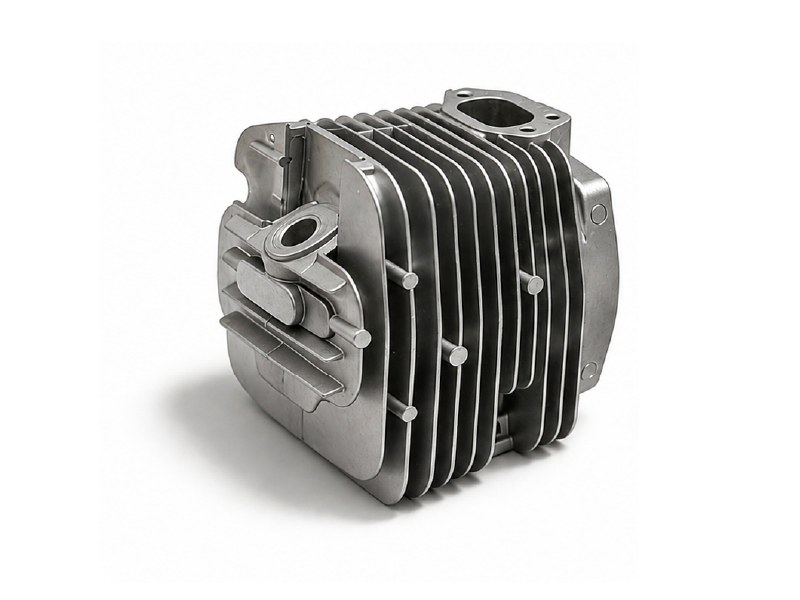
About the Case
Application: 50–500cc UAV Powertrain
Product: Engine Cylinder
Material: ADC10 (A380) Aluminum Alloy
Capabilities: High-Pressure Die Casting, CNC Machining, Leak Testing, Surface Finishing
Why Teamsworld
Customer Challenges:
A UAV engine manufacturer required lightweight yet durable engine cylinders capable of operating under continuous high temperatures and vibration. The components needed precise machining tolerances, excellent heat dissipation, and reliable sealing performance to maintain engine efficiency during extended flight missions. In addition, reducing machining time while maintaining dimensional accuracy was essential for cost-effective mass production.
Capabilities Leveraged:
Teamsworld utilized high-pressure aluminum die casting with ADC10 alloy to produce lightweight engine cylinders with complex cooling fin geometries.
Our DFM team optimized wall thickness and draft angles to improve mold filling and reduce porosity in critical sealing areas. Precision CNC machining ensured accurate bearing seats, cylinder interfaces, and mounting features, while leak testing verified sealing integrity before shipment.
Results:
The optimized die casting design reduced component weight while maintaining excellent structural rigidity and thermal performance.
The customer achieved:
Improved heat dissipation
Stable engine sealing performance
Reduced machining time
Higher production consistency for UAV engines
FAQ
Q1: Why is ADC10 aluminum alloy used for UAV engine cylinders?
A: ADC10 (A380) aluminum alloy is widely used for UAV engine cylinders because it offers an excellent balance of lightweight performance, castability, thermal conductivity, and mechanical strength. Combined with high-pressure die casting, ADC10 enables complex cooling fin designs while maintaining dimensional accuracy and reducing overall component weight. It is an ideal material for UAV powertrain components requiring efficient heat dissipation and reliable mass production.
Q2: What manufacturing processes are used for UAV engine cylinders?
A: UAV engine cylinders are typically manufactured using high-pressure aluminum die casting followed by precision CNC machining. Additional processes such as leak testing, surface finishing, and quality inspection ensure accurate sealing surfaces, tight machining tolerances, and consistent performance under high-temperature and high-vibration operating conditions.
Q3: How does DFM improve UAV engine cylinder manufacturing?
A: Design for Manufacturability (DFM) helps optimize UAV engine cylinder designs before production begins. By analyzing wall thickness, draft angles, cooling fin geometry, and machining allowances, DFM reduces porosity, improves mold filling, shortens machining time, and increases production consistency. This approach helps manufacturers achieve higher quality, lower manufacturing costs, and more reliable UAV powertrain performance.