
A380 vs. ADC12 Aluminum Alloys in Die Casting
Specifying the wrong aluminum alloy in a global die casting program can add 15% to material costs, push lead times out by four weeks, and introduce porosity defects that only surface after production has scaled. Yet it happens routinely because North American design teams default to A380 (ASTM), while Asian manufacturers run on ADC12 (JIS).
With AI server thermal modules and EV structural components now driving die casting demand at scale, the cost of getting this decision wrong has never been higher. This guide breaks down exactly where the two alloys differ in chemistry, mechanical performance, and supply chain reality, so you can make the right call before tooling is cut.
How Alloy Chemistry Affects Die Casting Performance
Understanding the distinction between A380 and ADC12 begins with materials science. Both alloys belong to the aluminum-silicon-copper (Al-Si-Cu) family, yet their compositional ratios differ in ways that have significant downstream consequences.
ADC12 contains silicon (Si) at a typical level of 9.6% to 12.0%. In high-pressure die casting (HPDC), this elevated silicon level substantially enhances the fluidity of molten aluminum and lowers its melting point. The result is a material that excels at filling intricate geometries and thin-wall sections. In Asia-dominated applications such as consumer electronics enclosures and precision sensor housings, ADC12 effectively penetrates fine mold cavities and minimizes cold shuts, making it the go-to alloy for complex, high-detail castings.
When to Choose ADC12?
Best Applications for Thin-Wall and Complex Die Cast Parts
For the following application scenarios, ADC12 is generally the more cost-effective choice:
Consumer Electronics Enclosures: Smartphones, laptop chassis, AI server thermal modules
Precision Sensor Housings: Thin-wall structures, high-detail surface requirements
High-Volume Asian Contract Manufacturing: Stable regional supply chain with no reliance on imported ingot materials
In high-pressure die casting (HPDC) operations, ADC12’s fluidity advantage translates directly into lower scrap rates and shorter cycle times, a meaningful factor in procurement decisions where cost optimization is paramount.
When to Choose A380?
Superior Tensile Strength for Structural and Automotive Applications
North American standard A380, while carrying a slightly lower silicon range of 7.5% to 9.5%, permits higher concentrations of copper (Cu) and zinc (Zn) within its chemical tolerances. This composition delivers superior mechanical strength and machinability.
From an engineering standpoint, A380 typically outperforms ADC12 in both yield strength and ultimate tensile strength, a primary reason why North American automotive manufacturers continue to specify it for engine components, transmission housings, and heavy-duty industrial brackets. When a product must withstand high-cycle fatigue loads or structural impact, the additional mechanical margin offered by A380 provides a more reliable safety buffer.
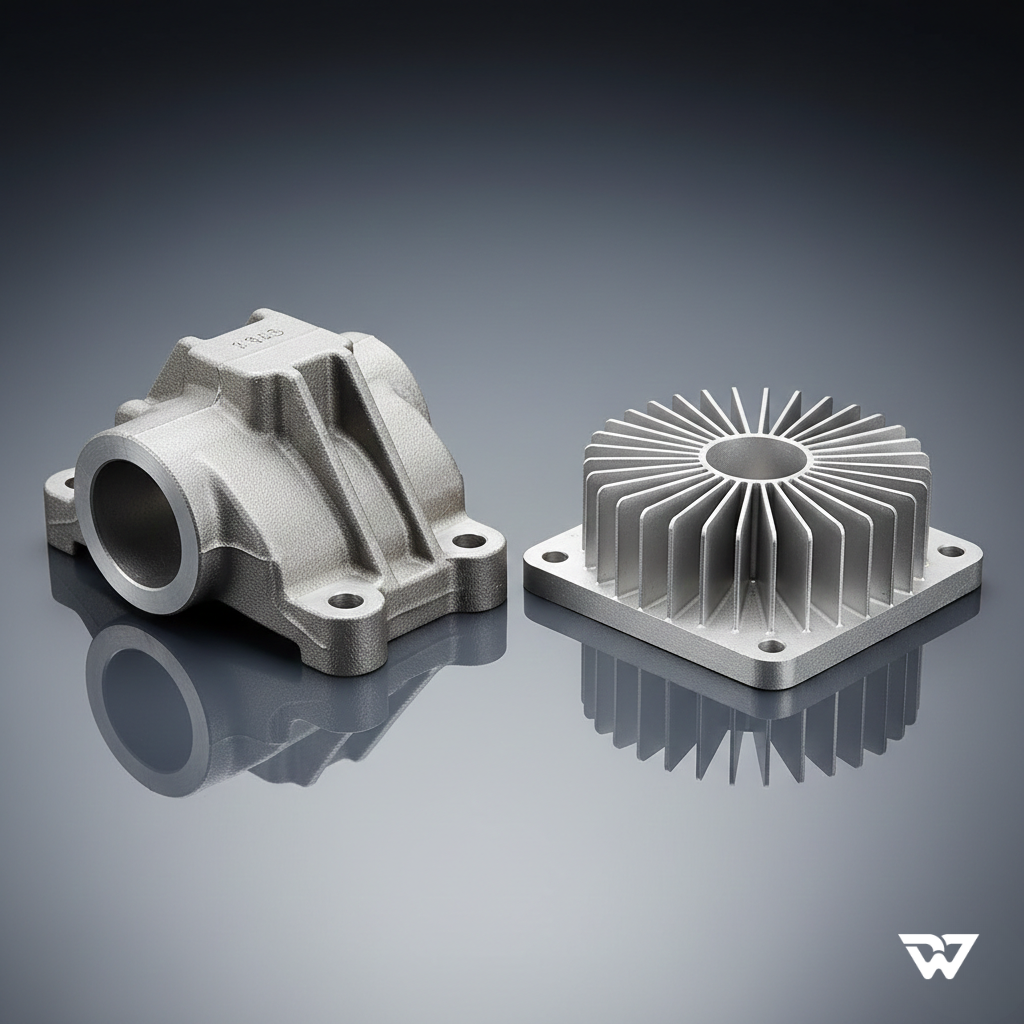
A380 vs. ADC12 Comparison
| Property | A380 (ASTM) | ADC12 (JIS) |
|---|---|---|
| Silicon Content (Si) | 7.5% – 9.5% | 9.6% – 12.0% |
| Copper Content (Cu) | 3.0% – 4.0% | 1.5% – 3.5% |
| Primary Market | North America, Europe | Asia (Taiwan, Japan) |
| Melt Fluidity | Moderate | Excellent |
| Tensile Strength | Higher | Moderate |
3 Costly Mistakes to Avoid When Sourcing Aluminum Die Cast Parts Across Regions
A frequent error among engineering teams engaged in multinational outsourcing is specification rigidity, insisting on one alloy without evaluating the regional context. The following are three recurring cost and technical pitfalls we observe when supporting global clients:
Regional Supply Chain Premium: Mandating A380 at Asian manufacturing sites, particularly in Taiwan and Southeast Asia, often requires the foundry to source specific ingot materials through import channels. This typically adds 10–15% to material costs and extends lead times by four weeks or more.
DFM Distortion and Tolerance Drift: If a design is dimensioned based on A380 shrinkage rates, but ADC12 is substituted during production without recalibrating the tooling, dimensional tolerances can exceed acceptable limits, driving up scrap rates and increasing post-machining costs.
Surface Treatment Incompatibility: The two alloys respond differently to secondary processes such as anodizing and powder coating. ADC12's higher silicon content can cause uneven coloration after anodizing, a quality issue that must be assessed before any material transition.
How Teamsworld Evaluates A380 vs. ADC12 Material Equivalency
As a manufacturing integration specialist headquartered in Taiwan with a global client base, Teamsworld understands that material selection is never a binary choice; it is a dynamic balance between performance requirements, manufacturing context, and cost objectives. Our value lies in Early Collaboration.
When clients approach us with designs specified for the A380, our engineering team does not proceed directly to production. Instead, we conduct a structured equivalency assessment to evaluate whether ADC12 can serve as a viable alternative without compromising the product's functional intent.
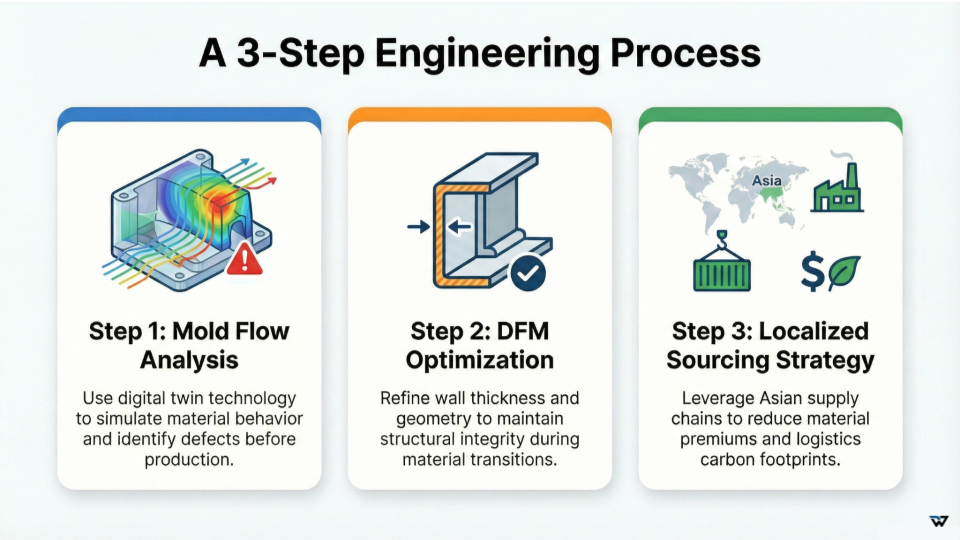
Step 1 — Mold Flow Analysis
Using digital twin technology, we simulate ADC12's fill behavior, cooling rate, and shrinkage distribution within the specified tooling geometry, identifying potential defect zones before a single shot is made.
Step 2 — DFM Optimization
We provide targeted recommendations on wall thickness, draft angles, and gate/runner systems to ensure that any material transition maintains the structural integrity and dimensional accuracy of the original design intent.
Step 3 — Localized Sourcing Strategy
Leveraging our deep supply chain network across Asia, we facilitate a seamless material transition to locally mainstream alloys, reducing logistics carbon footprint and eliminating the material cost premium, all without sacrificing product performance.
Choosing the Right Aluminum Alloy for Global Die Casting Sourcing: A380 or ADC12?
The choice between A380 and ADC12 is not a black-and-white decision. It is a calibrated trade-off between performance requirements, manufacturing geography, cost targets, and delivery timelines. The right material decision should be made at the design stage, not after tooling is cut.
Teamsworld is more than a die- casting parts manufacturer. We are your technical strategy partner in navigating a complex global supply chain. Whether you are evaluating a material equivalency transition or seeking an optimized die casting solution for Asian production, we invite you to engage our engineering team early.
FAQ - A380 vs. ADC12
Q1: Can ADC12 directly replace A380?
Not without evaluation. A direct substitution is inadvisable without a systematic assessment of the product's mechanical performance requirements, tooling design, and secondary processing specifications. In many applications, equivalency can be achieved with appropriate design adjustments; in others, parametric changes are required.
Q2: Which alloy is better suited for AI server thermal management components?
Most thermal management modules are thin-wall, high-complexity castings. ADC12's superior fluidity makes it a more suitable choice from a manufacturing standpoint, and its availability within the Asian supply chain offers stronger cost predictability.
Q3: Is sourcing A380 difficult in Asia?
It is feasible, but it comes with extended procurement lead times and a material cost premium. We strongly recommend addressing alloy strategy during the design phase in direct consultation with your Asian manufacturing partner to avoid costly corrections at the production stage.